
The missing link in net zero isn't technology, it's trust


The missing link in net zero isn't technology, it's trust
When people talk about the energy transition, the conversation usually centres on technology.
Can the grid cope with growing electricity demand? How quickly can heat pumps be deployed? Will battery storage scale fast enough? What role will hydrogen play? Are electric vehicles the future?
These are all important questions. But they are not the biggest challenge facing net zero. The core issue may be something far less tangible: trust.
For years, policymakers, industry leaders and energy companies have focused on solving technical barriers to decarbonisation. Yet many of the technologies needed to reduce emissions already exist. Renewable generation continues to grow, energy storage is improving, and innovation across the sector shows no signs of slowing.
What is becoming increasingly clear, however, is that technological progress alone will not deliver the energy transition. People have to come with it.
Northern Ireland's renewable energy success story
Northern Ireland is often cited as a renewable energy success story.
In a typical year, more than 40% of electricity demand is met through renewable generation, primarily wind power, and we have also reduced carbon emissions from electricity production.
Yet, despite these achievements, when major energy infrastructure projects are proposed, they often face delays, objections and resistance. So, if the public broadly supports climate action, why is there often opposition to the infrastructure required to deliver it?
The answer is not always about the technology itself. More often, it is about whether people trust the process behind it.
Consultation is not the same as participation
One of the most common mistakes in energy policy is assuming that public engagement is simply a communications exercise. Too often, communities are informed about decisions rather than involved in shaping them.
Projects are consulted upon after key decisions have already been made. Information is provided, public meetings are held, and feedback is requested. Technically, consultation has taken place, but participation is something different.
People are far more likely to support change when they feel they have genuine influence, when benefits are visible within their community, and when they believe decisions are being made with them rather than for them.
Awareness alone does not create support. Consultation alone does not create trust and this is ultimately what determines whether communities embrace change or resist it.
The cost of a trust deficit
A lack of trust creates costs that are rarely reflected in policy papers, these include projects that take longer to deliver, planning processes becoming more contentious, public scepticism growing and investment decisions becoming more uncertain. Over time, these challenges can become just as significant as any technical constraint.
The irony is that many net zero strategies focus heavily on engineering solutions while underestimating the human factors that determine whether those solutions can be successfully implemented.
Technology can solve a grid problem, but it cannot solve a trust problem.
What does a trusted energy transition look like?
Building trust requires more than better communication, it requires a shift in how energy policy is designed and delivered.
Energy projects should have tangible benefits for local communities and consumers should have a voice, their opinions influencing choices for these projects. Decisions making processes must be transparent and accessible, so people feel the transition is being done with them, not to them.
This is particularly important at a time when households continue to face cost-of-living pressures and growing demands are being placed on consumers to change how they heat their homes, travel and use energy.
Public support cannot be taken for granted, it must be earned.
The future of net zero will undoubtedly require investment in infrastructure, technology and innovation. But the transition will not succeed simply because the technology works, it will succeed because people believe in it.
Trust is often treated as a secondary consideration in energy policy. In reality, it may be one of the most important pieces of infrastructure we need to build.
Because no matter how advanced the technology becomes, the energy transition ultimately depends on public confidence, public participation and public consent.
The missing link in net zero is not technology. It is trust.
Before you fly off...
From the press...

Share Energy Shines at the AIB BusinessEye Awards
Share Energy was recognised with one of the top awards of the night.
From the Blog...

Share the Spotlight: Behind the Switch with Grace
Get to know the people behind Share Energy — and hear what they really think about the energy market, electricity bills, and how we can all do things better.
In the community...
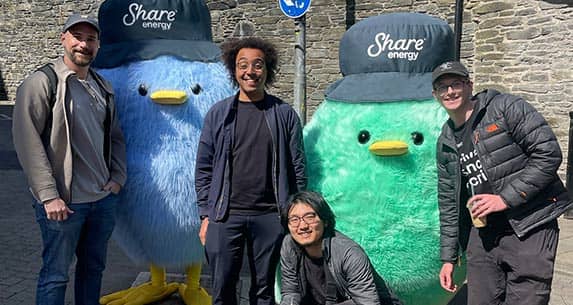
Share Energy mascots jazz it up at festival in Derry
Our favourite swingin’ pair soaked up the sunshine and the sounds at the City of Derry Jazz & Big Band Festival.